

Projects of Doctoral Students
Welcome to the DH Lab doctoral students' project page! Here we present the innovative projects of our PhD students. Each project marks a significant step in research and demonstrates the diversity of topics we explore. Immerse yourself in the world of Digital Humanities, enriched by the work of our talented researchers.
Supervisors: Prof. Dr. Lukas Rosenthaler, Prof. Dr. Gerhard Lauer (Johannes Gutenberg University, Mainz)
Supervisors: Prof. Dr. Peter Fornaro, Prof. Dr. Lukas Rosenthaler.
Supervisors: Prof. Dr. Rosa Lavelle-Hill, Prof. Dr. Mirka Henninger
The digital revolution has irrevocably redefined cultures of reading, prompting a re-evaluation of the physical book’s enduring significance in the contemporary literary sphere. Technology, both metaphorically and methodically, impacts the fundamental fabric of print. My PhD research is rooted in the transformation of textuality, the structural and conceptual strategies of experimentation, the consequent reflections in reading cultures, and what can and will be done with ‘books’ with and around the ‘digital.’ Notably, the digital turn has fascinatingly highlighted the orality inherent in book production and has encouraged a deeper exploration of what people do or did with books other than read them.
The project studies the complex and dynamic reading culture anchored in contemporary experimentality that reflects textuality as a process and the existence of a book as a remediation that carries its own historical and cultural consciousness. Experimental, in this context, conveys the subversive departure from the conventional. The study strives to analyze the expression of the hopes of hybridity that retains what we have traditionally associated a book with, accommodating and withstanding the pressures of digitality. Furthermore, the project attempts to examine the boundaries of a text that has to fight to exist as a text in the conventional sense, to capture the robustness of the technological realm, and in efforts to retain, reinvent its value as an artifact, medium, and mode. It intends to study selected texts to analyze the multi-genre and multi-vocal qualities of the texts to express a confrontation with digital textuality, a way of asserting and experimenting with print in the face of the digital.
Supervisors: Prof. Moniek M. Kuijpers, Prof. T. Ravichandran (IIT Kanpur)
Personal Website: www.abhiramiajith.com
Abhirami Ajith Kumar is a PhD candidate in English at the Department of Humanities and Social Sciences, Indian Institute of Technology, Kanpur. She is the recipient of the Swiss Government Excellence Scholarship, and as Research Fellow of the Digital Humanities Lab, University of Basel, is conducting the project “What to Expect While Experimenting with the Digital and/in the Textual: The Poetics of Convergence”.
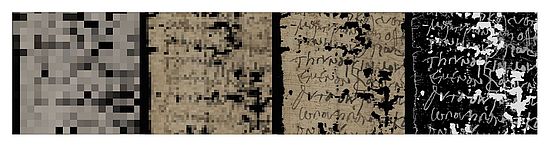
This work “Spectrum of Papyrus Image Quality (Ghent, P. 69)” is a derivative of “Brief” by Universiteitsbibliotheek Gent, marked with CC0 1.0 Universal. This derivative © 2024 by Victoria G. D. Landau is licensed under CC BY-NC-SA 4.0.
The world is witnessing digital transformations at an unprecedented pace, offering an immense potential that many disciplines, especially within the humanities and social sciences, are not yet equipped to handle. Questions about and challenges facing human heritage and information are at the forefront of debates in all sectors, equally overestimating and disparaging digitization processes and born-digital resources. This doctoral project explores the dimensions of 21st-century data management and preservation of cultural heritage, foremost ancient heritage, to ensure long-term access for research, institutional and public purposes.
This investigation includes an examination of what we understand as «cultural heritage» and «ancient heritage», how this translates into a digital understanding, and which analog and digital standards and best practice approaches are already in use and will be viable in the future — to support both large-scale initiatives (e.g., those adhering to the 1972 UNESCO World Heritage Convention or the Memory of the World Programme) and often subject-specific, medium-scale enterprises, such as collections, archives, databases, and research projects. Generating common ground will require conscious transdisciplinary efforts, shared cross-disciplinary concepts and vocabularies, as well as interoperable systems and structures.
In order to physically retain and digitally capture cultural objects themselves, a vital element in the protection and preservation of cultural heritage is understanding the many threats to cultural property — natural hazards, armed conflict, and obsolescence, both analog and digital, as well as individual human factors such as neglect, fragmentation of artefacts, trafficking, profiteering, and insufficient funding. Looking into the past by incorporating discussions of provenance and acquisition, and anticipating the future by outlining preparation steps for both best- and worst-case scenarios, the thesis further aims to illustrate the links between and the responsibilities of key actors involved. Merging humanities challenges with digital pathways, it intends to produce individually tailored and generally suitable processes that contribute to a landscape of heritage accessible to all.
Supervisors: Prof. Dr. Peter Fornaro, Prof. Dr. Aden Kumler
Member of the Graduate School of Social Sciences (G3S): Profile
South Korean Protestant communities have played a central role in anti-LGBTQ+ discourse since the first proposed anti-discrimination legislation in 2007, producing deep tensions between faith and queer identity. While existing studies have examined LGBTQ+-affirming churches or contested biblical interpretations of homosexuality, they often remain within Protestant theological frameworks. This research shifts focus to how queer Christians deconstruct institutionalized religious power and reconstruct faith and identity through both physical and digital spaces of resistance.
Digital platforms have become crucial arenas in these processes. Queer Christians use online communities to explore alternative theologies, share experiences, and organize gatherings beyond traditional church gatekeeping, while anti-queer Christian groups simultaneously mobilize digital media to amplify antagonism and political opposition. This duality reveals digital space as both a site of liberation and ideological control.
Combining digital ethnography, interviews, discourse analysis, and game-based methods, this study highlights how digital media and play reshape religious authority, foster queer Christian alliances, and enable new forms of political imagination in South Korea.
Personal website: http://jisoolim.me/
Supervisor: Prof. Dr. Ranjodh Singh Dhaliwal
Supervisors: Prof. Dr. Peter Fornaro, Prof. Dr. Lukas Rosenthaler, Prof. Dr. Karolina Soppa (Bern University of Applied Sciences)
This project positions itself at the intersection of AI innovation and the intellectual achievements of the humanities and art history. In light of the challenges presented by NLP and CV methods in humanities research, it endeavors to create a symbiotic relationship that will enable a critical digital space for the analysis and assessment of the visual arts.
Supervisors: Prof. Dr. Peter Fornaro, Prof. Dr. Lukas Rosenthaler, Prof. Dr. Gerhard Lauer (Johannes Gutenberg University, Mainz)
This investigation focuses on the study of printers and publications within the Sephardic community of Amsterdam (16th and 17th centuries), framed within the SNSF project Mapping the Scriptures in Western Sephardi Literature. The research explores how bibliographic and personal records of key publishing agents are structured through the development of an ontology, facilitating the creation of an open linked database. This digital framework not only captures historical data but also aims to support medium-scale scholarly initiatives involving archives, collections, and research databases.
To safeguard and preserve this bibliographic heritage, it is crucial to address various challenges, including the fragility of historical documents, the dispersion of archival materials, and the potential obsolescence of digital platforms. The thesis examines past acquisition and provenance practices, while also proposing future strategies to ensure the interoperability of systems and the sustainability of digital infrastructures. By integrating humanities-focused research with innovative digital methodologies, this work seeks to establish a standardized yet adaptable approach that enriches the accessibility and preservation of the Sephardic publishing legacy.
Supervisors: Prof. Dr. Lukas Rosenthaler, Prof. Dr. Harm den Boer
The dissertation investigates the question of local social changes and to what extent these are reflected in the Schnitzelbänke of the UNESCO Basel Fasnacht, employing big data analytics to uncover patterns and insights.
Supervisors: Prof. Dr. Peter Fornaro, Prof. Dr. Walter Leimgruber
Quick Links